
Trade Gold, Silver & More on MCXwith Ashlar India
Trade commodity futures and options on MCX and NCDEX — gold, silver, crude oil, copper, and agricultural commodities — through a SEBI-regulated broker, fully online, with real-time prices and professional research support.SEBI-Registered · MCX Member · NCDEX Member


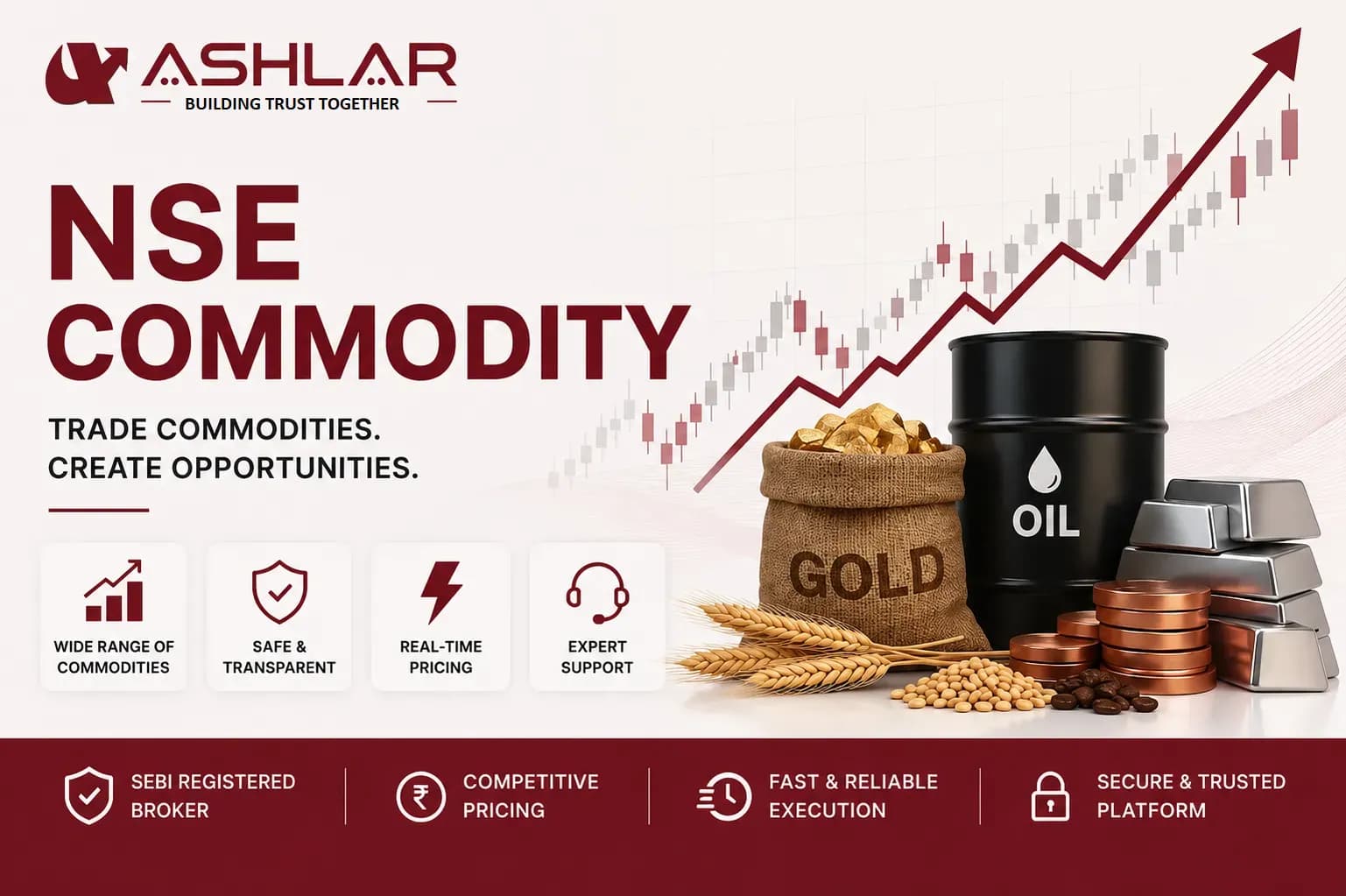
What if you could trade gold, oil & wheat from your phone?
Did you know you can invest in gold without buying physical gold jewellery? Or that you can trade crude oil, silver, copper, and even agricultural products — all from your phone — without ever touching the actual commodity?
This is the world of commodity trading in India — and it is growing fast. Every day, lakhs of Indians trade commodities on MCX and NCDEX.
Invest in gold without storing physical gold
Trade crude oil, silver & copper from your phone
Hedge crop prices like professional farmers
Diversify your portfolio beyond stocks
You do not need to be an expert.
You just need the right broker, the right platform, and this guide.
Trusted by lakhs of Indian investors
Welcome to Ashlar India — your MCX & NCDEX broker.
What Is Commodity Trading?
Explained in Simple Words
A commodity is a basic raw material or natural product that people buy, sell, and use every day. Things like:
Gold & Silver
Precious metals
Crude Oil & Natural Gas
Energy
Copper, Zinc, Aluminium
Base metals
Wheat, Soybean, Cotton, Spices
Agricultural
Commodity trading means buying and selling these raw materials — not physically, but through standardised contracts on a regulated exchange.
How Is It Different from Buying Physical Gold?
Physical Gold
- ✕ Pay making charges
- ✕ Store it safely
- ✕ Worry about purity
MCX Gold Contract
- ✓ Track price movements
- ✓ Profit from changes
- ✓ Store nothing
Where Does Trading Happen?
Two main commodity exchanges in India:
Multi Commodity Exchange
India's largest. Metals & energy — gold, silver, copper, crude oil, natural gas.
National Commodity & Derivatives Exchange
Agricultural commodities — wheat, soybean, chana, cotton, spices.
Both regulated by SEBI — the same regulator that oversees the stock market.
Benefits of Commodity Trading in India
Commodity derivatives provide a distinct asset class with its own return drivers — diversifying beyond equities, hedging inflation, and offering two-directional trading opportunities.
Portfolio Diversification
Distinct asset class — behaves differently from equities
Inflation Hedge
Gold, silver, crude oil tend to rise with inflation
Exchange Regulated
SEBI-regulated MCX and NCDEX — transparent pricing
Global Price Discovery
Prices linked to LME, COMEX, and NYMEX globally
Portfolio Diversification Beyond Equities and Fixed Income
Commodity derivatives provide exposure to a distinct asset class with its own return drivers — supply-demand dynamics, geopolitical factors, currency movements, and global industrial activity — which often behave differently from equity markets.
Hedging Against Inflation
Precious metals such as gold and silver, and energy commodities such as crude oil, have historically tended to appreciate during inflationary periods. Commodity exposure can serve as a partial hedge against erosion of purchasing power.
Online Gold and Silver Trading — Price Transparent, Exchange Regulated
MCX provides a fully regulated, transparent marketplace for precious metals trading. Prices are exchange-determined and publicly visible in real time — with no making charges, no purity uncertainty, and no storage or insurance logistics.
Leverage — Margin-Based Trading
Commodity futures contracts require only a fraction of the total contract value as initial margin. This leverage allows exposure to a larger notional value with smaller upfront capital — but losses can accumulate quickly and may exceed your initial margin. Risk management is essential.
Global Price Discovery
MCX commodity prices are determined in reference to international benchmark markets — the London Metal Exchange (LME) for base metals, COMEX for gold and silver, and NYMEX for crude oil — within a domestic, SEBI-regulated framework.
Opportunities in Both Rising and Falling Markets
Commodity futures allow you to go long (buy) if you expect prices to rise, or go short (sell) if you expect prices to decline. This two-directional flexibility means trading opportunities exist across various market environments.
Hedging for Agricultural Businesses
Farmers, commodity traders, processors, and food businesses can use NCDEX to lock in prices for their produce or raw material inputs through regulated futures contracts — protecting against adverse price movements and improving business planning certainty.
How Does Commodity Trading Work?
Investing in commodity derivatives through Ashlar India is fully digital and takes under 15 minutes to set up. Here is the complete process.
Open Your Commodity Trading Account
Visit ashlarindia.com and open your account fully online in under 15 minutes. You will need your PAN card, Aadhaar, and bank account details. Ashlar India provides access to both MCX and NCDEX through a single integrated trading account.
ashlarindia.comComplete KYC and Commodity Segment Activation
Submit your KYC documents digitally. Once verified, the commodity derivatives segment is activated on your trading account. No physical paperwork or branch visit is required. You will also receive and must sign the mandatory Risk Disclosure Document for commodity derivatives trading.
Transfer Funds as Margin
Add funds to your Ashlar India trading account. For commodity futures trading, you are required to maintain an initial margin — the minimum amount mandated by the exchange for holding an open contract position. Margin requirements are set by MCX/NCDEX and vary by commodity and prevailing market volatility.
Select Your Commodity and Contract
Log in to the Ashlar India platform and select your commodity — for example, Gold (1 kg contract) or Gold Mini (100 gram contract) on MCX. Choose your contract expiry month. Each contract has defined specifications for lot size, quality grade, and delivery terms.
Analyse the Market
Use Ashlar India's published research, live price charts, technical analysis tools, and daily commodity reports. Consider both domestic factors (currency movements, Indian demand) and global factors (international benchmarks, geopolitical developments, supply data). Make an informed, research-supported decision before trading.
Place Your Buy or Sell Order
Enter your order — number of lots, order type (market or limit), and direction (buy or sell). Your order is placed on MCX or NCDEX through Ashlar India's regulated platform and executed at the prevailing exchange price.
Monitor, Manage Risk, and Exit
Monitor your open positions on the Ashlar India platform or mobile app. Use stop-loss orders to limit downside risk. When your target is reached — or before contract expiry — square off your open position. Do not hold futures positions to expiry unless you intend to participate in the physical delivery process.
Why Choose Ashlar India for Commodity Trading?
Ashlar Securities Pvt. Ltd. is a SEBI-registered stockbroker and a member of both MCX and NCDEX — providing a regulated, transparent, and well-supported commodity trading environment.
Access to MCX and NCDEX — Both in One Account
Trade all major commodities — gold, silver, crude oil, copper, agricultural products — across both MCX and NCDEX from a single unified account.
Best Commodity Trading Platform in India
Live MCX and NCDEX prices, interactive charts, contract details, margin calculator, and one-click order placement — all in one clean interface.
Competitive Brokerage and Low Charges
Ashlar India offers competitive brokerage rates with absolutely no hidden charges — so you keep more of your profits.
Daily Commodity Research and Price Forecasts
Every trading day, Ashlar India's research team publishes commodity reports with price targets, support/resistance levels, and trade ideas.
Trade Gold and Silver Online with Confidence
Trade the full Gold (1 kg) contract or start small with the Gold Mini (100 grams) or Gold Guinea (8 grams). Flexible access to precious metals on MCX.
Mobile Trading App for Commodity Markets
Trade commodities from anywhere in India. Real-time MCX and NCDEX prices, push notifications on price alerts, and seamless order management.
Margin Calculator and Risk Tools
Use Ashlar India's margin calculator before any trade to know exactly how much margin you need. Set stop-loss orders automatically to manage risk.
SEBI Registered and Fully Compliant
Ashlar Securities Pvt. Ltd. is a SEBI-registered broker and a member of MCX and NCDEX. Your trades, funds, and data are fully protected.
Dedicated Customer Support
Questions about a gold contract? Confused about crude oil lot size? Our expert support team is available to guide you — in simple language.
Common Mistakes in Commodity Trading (And How to Avoid Them)
Commodity futures markets are volatile and leverage-intensive. These are the most common errors retail traders make — and how to avoid them.
The Mistake
Not Understanding Contract Specifications
How to Avoid
Every commodity futures contract on MCX or NCDEX has defined parameters: lot size, contract expiry date, delivery centre, quality specifications (grade), tick size, and margin requirements. (E.g., 1 lot of Gold on MCX = 1 kg; 1 lot of Crude Oil = 100 barrels.) Always review the official contract specifications on the MCX or NCDEX website before placing your first trade in a new commodity.
The Mistake
Ignoring Global and Macroeconomic Factors
How to Avoid
Commodity prices are substantially driven by global events: US Federal Reserve interest rate decisions, OPEC production decisions, China's industrial output data, monsoon forecasts for agricultural commodities, and geopolitical developments in key producing regions. Follow Ashlar India's daily commodity research and reputable news sources to stay informed on the key drivers for the commodities you trade.
The Mistake
Over-Leveraging on a Single Commodity Position
How to Avoid
Deploying your entire available margin into a single commodity position concentrates risk dangerously. Individual commodity prices can move 3–5% or more in a single trading session. Maintain diversification across 2–3 commodity positions where possible, and never risk more capital than you can genuinely afford to lose.
The Mistake
Not Managing Expiry Dates and Physical Delivery Risk
How to Avoid
MCX commodity futures contracts expire monthly. If you hold an open futures position through the contract's tender period or delivery period without squaring off, you may become subject to physical delivery obligations. Physical delivery is operationally complex and is not appropriate for most retail traders. Always close open positions well before the contract's expiry/tender period commences.
The Mistake
Trading Without a Pre-Defined Stop-Loss
How to Avoid
Commodity markets are volatile. Crude oil prices can decline sharply on geopolitical developments or OPEC supply decisions. Gold can spike significantly overnight on safe-haven demand. Natural gas prices are among the most volatile commodity instruments. Always define your maximum acceptable loss per trade before entering a position and place stop-loss orders accordingly.
The Mistake
Acting on Unverified Information or Informal Tips
How to Avoid
Commodity markets attract a disproportionate volume of unverified 'tips' — particularly around budget announcements, OPEC meetings, or periods of global uncertainty. Never trade based on information from unverified social media groups, messaging app forwards, or anonymous sources. SEBI prohibits market manipulation and the circulation of misleading price-sensitive information. Trade only on the basis of verified research, exchange data, and your own informed analysis.
The Mistake
Overlooking Currency Risk
How to Avoid
The majority of commodity prices on MCX are denominated in Indian Rupees, but derive from international prices quoted in US Dollars. A depreciation of the Indian Rupee against the US Dollar will push domestic MCX prices higher even if the international price of the commodity has not changed — and vice versa. Monitor the USD/INR exchange rate as a relevant input when assessing commodity price direction on MCX.
Always review the official MCX contract specifications before trading a new commodity. Use stop-losses on every trade, diversify across 2–3 positions, exit before the tender period, and trade only on verified research — never unverified tips.
Frequently Asked Questions
Everything you need to know about commodity derivatives trading in India.
Commodity derivatives trading involves buying and selling standardised futures or options contracts linked to underlying raw materials — such as gold, silver, crude oil, copper, or agricultural commodities — on SEBI-regulated exchanges like MCX and NCDEX. Retail traders typically do not take or make physical delivery of the commodity; instead, they profit from price movements by squaring off their positions before contract expiry.
MCX (Multi Commodity Exchange of India) is India's largest commodity derivatives exchange, focused primarily on metals (gold, silver, copper, zinc, aluminium) and energy (crude oil, natural gas). NCDEX (National Commodity and Derivatives Exchange) focuses on agricultural commodities — wheat, soybean, chana, cotton, castor seed, and spices. Ashlar India provides access to both exchanges from a single trading account.
Yes. On MCX, gold futures contracts track the price of physical gold of defined purity. You buy or sell contracts based on your market view and, if you square off before expiry, no physical gold changes hands. There are no making charges, no purity concerns, and no storage requirements. You earn (or lose) based on the price movement of the contract during your holding period.
A lot is the standardised minimum trading unit for a commodity futures contract on MCX or NCDEX. Trading must occur in whole lots — no fractional lots. Indicative lot sizes on MCX include: Gold — 1 kg; Gold Mini — 100 grams; Gold Guinea — 8 grams; Silver — 30 kg; Crude Oil — 100 barrels. Always verify current lot sizes on the MCX website or via Ashlar India's platform, as exchange contract specifications may be revised.
Upon contract expiry, open futures positions that have not been squared off become subject to the physical delivery process — the seller is obligated to deliver the specified quantity and quality of the actual commodity, and the buyer is obligated to accept and pay for it. MCX has defined delivery centres and quality specifications for each commodity. Most retail traders close their positions before the tender period to avoid physical delivery obligations.
Commodity futures trading involves significant market risk and leverage, which can amplify losses as well as gains. Beginners should invest time in understanding contract specifications, margin requirements, and risk management before live trading. Starting with smaller-lot contracts — such as the Gold Mini (100 gram) contract on MCX — helps limit initial capital exposure while you develop market understanding. Ashlar India provides educational resources and research to support informed decision-making.
Minimum capital requirements depend on the specific contract and prevailing exchange-mandated margin rates. As an indicative guide: the Gold Mini contract (100 grams) on MCX has typically required initial margins in the range of ₹15,000–₹25,000, depending on exchange-set margin rates at the time of trading. Crude Oil and full Gold contracts (1 kg) require substantially higher margins. Use Ashlar India's margin calculator for the current, exact margin requirement before placing any trade — margin requirements change with market volatility.
MCX commodity markets operate from 9:00 AM to 11:30 PM IST on regular trading days. This extended session — significantly longer than NSE/BSE equity market hours (9:15 AM to 3:30 PM) — allows Indian traders to monitor and react to international commodity price developments across the London and New York trading sessions. Agricultural commodities on NCDEX have their own defined trading hours; check the NCDEX website for current session timings.
Profits from commodity futures trading are generally taxable as business income under the Income Tax Act, 1961 — subject to tax at the applicable income tax slab rate. Agricultural commodity transactions may attract different tax treatment in certain circumstances. CTT (Commodities Transaction Tax) applies to non-agricultural commodity derivatives. Investors are advised to consult a practising Chartered Accountant for tax guidance specific to their trading activity and income profile.
Yes. Ashlar Securities Pvt. Ltd. is a SEBI-registered stockbroker and a member of both MCX and NCDEX. All commodity derivatives transactions placed through Ashlar India are exchange-executed, regulated under SEBI's framework, and cleared through the respective exchange clearing corporations.
Start Commodity Trading with Ashlar IndiaToday
Gold prices respond to global uncertainty. Crude oil reacts to OPEC decisions and geopolitical developments. Silver tracks both industrial demand and safe-haven sentiment. Copper reflects global industrial and infrastructure activity. Commodity derivative markets are active, globally connected, and offer genuine opportunities for informed participants — in both rising and falling price environments.
They need someone they trust to guide them. Commodity markets offer opportunities in both rising and falling environments.
"Open your free commodity-enabled trading account — 100% online in under 15 minutes."
Our team is available to assist you — from account opening and segment activation through to your first commodity trade on MCX.
With Ashlar India, you get:
- Single-account access to MCX and NCDEX
- Trade gold, silver, crude oil, copper, agri-commodities, and more
- Fast, reliable platform with live exchange prices and charts
- Daily commodity research reports and technical analysis
- Transparent brokerage with no hidden charges
- Risk management tools — margin calculator and stop-loss functionality
- Mobile application for trading from any location
- SEBI-registered, MCX and NCDEX member — fully regulated
SEBI Registered · MCX Member · NCDEX Member · 100% Online
15 Years of Excellence in Commodity Trading
A journey of trust, innovation, and wealth creation since 2009.
Founded
Began journey with a vision for transparent investing
SEBI Registered
First major regulatory milestone achieved
Digital Transformation
Launched advanced trading platforms
15 Years Strong
Serving 20k+ happy investors across India
Over a decade of trusted financial expertise across India.
Crores in trades executed with precision and reliability.
Investors who trust us to grow and protect their wealth.
Expert support available every day of the trading week.