
Investin Bonds in IndiaGovernment Bonds & NCDs
Explore reliable investment opportunities through government bonds, treasury bills, and fixed-income securities with stable long-term returns.15 years of empowering investors.


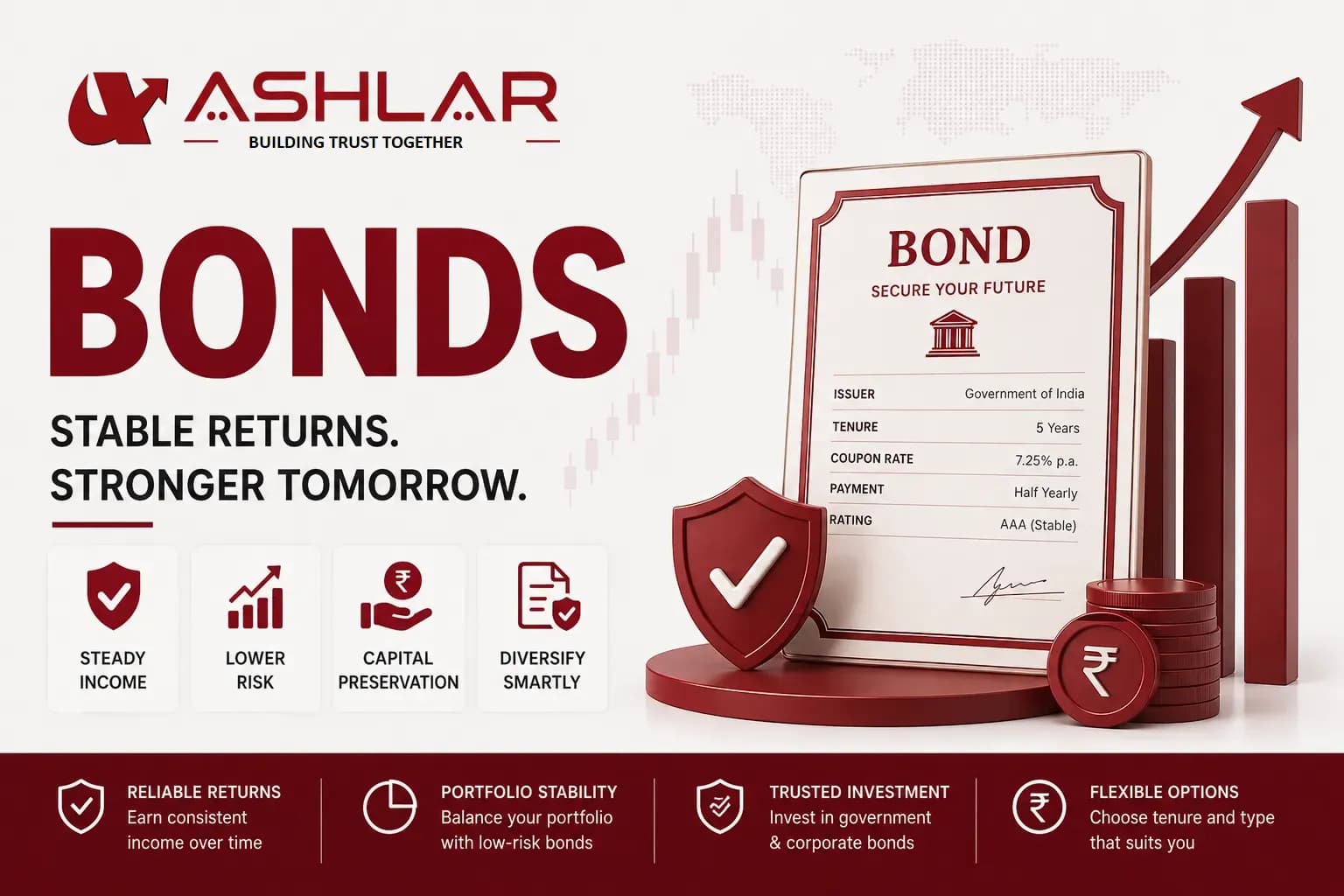
There is a category of investment that many experienced Indian investors quietly rely upon for steady, predictable returns — without direct equity market exposure.
They are called bonds.
Bonds rarely make headlines the way a stock market rally does. They do not generate excitement the way a high-profile IPO might. But year after year, they serve a critical purpose in a well-constructed investment portfolio — providing fixed, scheduled income, protecting capital, and allowing savings to grow steadily over a defined period.
India's bond market in 2026 offers genuine opportunities that many retail investors have not fully explored. Government securities (G-Secs), corporate bonds, and NCDs (Non-Convertible Debentures) currently offer yields ranging from approximately 7.5% to 10%+ per annum — meaningfully higher than standard savings accounts and competitive with, or above, many bank Fixed Deposits.
Through Ashlar India — a SEBI-registered stockbroker and NSE/BSE member — you can invest in bonds from India's regulated issuers, fully online, with complete transparency, and with investment amounts starting from as little as ₹1,000 (for eligible government securities via the exchange).
This guide explains the fundamentals — what bonds are, how they function, why they may suit your portfolio, and how Ashlar India makes bond investing accessible for retail investors.
What Are Bonds?
A bond is, in essence, a loan you provide to a government or a company.
When the Government of India needs to fund public expenditure — infrastructure, healthcare, defence — or when a regulated company needs capital to expand its operations, they raise funds from investors in the form of bonds.
In return, they commit to paying you a fixed rate of interest (called a coupon) at regular intervals, and returning your full principal on a specified future date (called the maturity date).
Suppose you invest ₹1 lakh in a bond for 5 years at a coupon rate of 9% per annum.
Each year, the issuer pays you ₹9,000 as interest.
At the end of 5 years, your ₹1 lakh principal is returned.
Total receipts: ₹45,000 in coupon income + ₹1,00,000 principal returned = ₹1,45,000.
The income and principal repayment are pre-determined from the date of investment.
Unlike equity investments, bond returns do not fluctuate with market sentiment — provided you hold to maturity and the issuer does not default.
Types of Bonds You Can Invest In
Government Bonds (G-Secs)
Issued by the Government of India or state governments. Backed by sovereign guarantee — meaning the government itself promises repayment. Among the safest investments available in India. Traded on NSE and BSE. Returns currently range from 6.5% to 7.5% per year.
RBI Floating Rate Savings Bonds
Issued by the Reserve Bank of India. Interest rate is linked to the National Savings Certificate (NSC) rate + 0.35% — currently offering around 8.05%. Available for Indian resident individuals and HUFs. 7-year tenure with no premature withdrawal for most investors.
Sovereign Gold Bonds (SGBs)
Issued by the Government of India on behalf of RBI, linked to the price of gold. Offer 2.5% fixed annual interest plus capital appreciation if gold prices rise. 8-year tenure with exit option from Year 5. Tax-free on redemption at maturity.
Corporate Bonds
Issued by well-rated companies to raise funds. Offer higher interest rates than government bonds — typically 8% to 10%+ per year — in exchange for slightly higher (but well-managed) credit risk. Rated by agencies like CRISIL, ICRA, and CARE.
NCDs (Non-Convertible Debentures)
A specific type of corporate bond that cannot be converted into equity shares. Issued by NBFCs, housing finance companies, and large corporations. Traded on NSE and BSE after listing. Offer some of the highest fixed-income returns available in India — 9% to 10.5%+ for top-rated issuers.
Tax-Free Bonds
Issued by government-backed entities like NHAI, REC, and PFC. The interest earned is completely exempt from income tax — making the effective return significantly higher for investors in the 30% tax bracket. Currently available mostly on secondary markets.
PSU Bonds
Issued by Public Sector Undertakings — government-owned companies like NTPC, HUDCO, IRFC. Carry high credit ratings and offer better returns than bank FDs with strong safety.
Benefits of Investing in Bonds
From guaranteed returns to tax-free income — bonds offer a smarter, safer way to grow your wealth without the stress of market volatility.
Fixed, Predictable Income
Know exactly how much you earn and when
Capital Protection
Your principal is returned in full at maturity
Returns Above Bank FDs
Earn 8% to 10.5%+ with quality corporate bonds
Tax-Free Options
SGBs and tax-free bonds offer exceptional post-tax returns
Fixed, Predictable Income
Bonds pay a fixed coupon rate — you know exactly how much you will earn and when. This makes them ideal for retirement planning, regular income needs, and risk-averse investors who want certainty over speculation.
Capital Protection
Your principal is returned in full at maturity. Unlike stocks or mutual funds, bonds do not expose your invested capital to market fluctuations. What you put in comes back — along with all promised interest.
Returns Above Bank FDs
Quality corporate bonds and NCDs offer 8% to 10.5%+ per year — significantly higher than most bank FDs at 6.5–7.5%. Government bonds offer 6.5–7.5%, and when tax-free bonds are factored in, the effective return for high-income investors can be even more attractive.
Portfolio Diversification
Bonds behave differently from stocks. When equity markets are volatile or falling, high-quality bonds often hold steady or even increase in value. Adding bonds to a stock-heavy portfolio reduces overall risk without necessarily reducing long-term returns.
Regular Interest Payouts
Most bonds pay interest semi-annually or annually — directly to your bank account. This creates a reliable cash flow — perfect for retirees, homemakers, or anyone who wants passive income without selling assets.
Government Bond Safety
G-Secs and RBI-issued bonds carry a sovereign guarantee — the safest possible guarantee in any country. There is zero credit risk on government bonds. Your money is as safe as it can possibly be.
Tax Efficiency with Tax-Free Bonds and SGBs
Tax-free bonds are exactly what the name says — the interest is exempt from income tax entirely. SGBs are tax-free on capital gains at maturity. For investors in higher tax brackets, these instruments offer exceptional post-tax returns.
Liquidity Through Exchange Trading
Most listed bonds and NCDs can be bought and sold on NSE and BSE before maturity — giving you the option to exit if needed. Unlike a bank FD with early withdrawal penalties, listed bonds offer genuine market liquidity.
How to Invest in Bonds with Ashlar India
Ashlar India makes bond investing fully digital and beginner-friendly. Here is exactly how to get started:
Open or Log In to Your Ashlar India Account
Visit ashlarindia.com and log in to your Demat and trading account. New to Ashlar India? Open your free account in under 15 minutes — PAN, Aadhaar, and bank details are all you need.
ashlarindia.comNavigate to the Bonds Section
Go to ashlarindia.com/invest-in-bonds-india-8-percent-return. You will see all currently available bonds and NCDs — government bonds, corporate bonds, PSU bonds, SGBs, and NCD listings — with full details and live prices.
Understand the Bond Details
For each bond, Ashlar India displays the issuer name and credit rating which you should always check first, the coupon rate which is the fixed interest rate per year, the tenure and maturity date when you get your principal back, the interest payout frequency which can be monthly, quarterly, semi-annual, or annual, the minimum investment amount, whether it is listed on NSE/BSE for liquidity, and the Yield to Maturity (YTM) which is the effective annual return if you hold till maturity.
Compare and Filter Bonds
Use Ashlar India's filter tools to sort by return, tenure, rating, issuer type, or payout frequency. Looking for bonds above 9%? Filter by return. Want government safety? Filter by issuer type. Find exactly what suits your need.
Apply for New NCD Issues (During IPO Window)
When a company launches a new NCD, it opens a public subscription window — similar to a stock IPO. During this period, you can apply for the NCD at the original issue price directly through Ashlar India. After listing, NCDs trade on NSE/BSE and you can buy or sell at market prices.
Buy Listed Bonds on NSE/BSE
For bonds already listed on the exchange, simply search for the bond on the Ashlar India trading platform and place a buy order — exactly like buying a share. Your bonds are credited to your Demat account.
Set Up Interest Credit to Your Bank Account
Register your bank account details with the bond issuer or registrar for automatic interest (coupon) payments. Ashlar India guides you through this process for each bond type.
Track Your Bond Portfolio
All your bonds — government, corporate, SGBs, NCDs — are visible in your Ashlar India Demat account. Track current value, accrued interest, next payout date, and maturity date from a single dashboard.
Exit or Hold to Maturity
Listed bonds can be sold on NSE or BSE any trading day. If you hold to maturity, the principal is automatically credited to your bank account on the maturity date. Ashlar India sends you maturity alerts in advance.
Why Choose Ashlar India as Your Broking Partner?
Eight reasons why thousands of partners across India trust Ashlar to build their business.
Complete Bond Marketplace — All Regulated Instruments in One Place
Government securities, corporate bonds, PSU bonds, NCDs, SGBs, RBI Savings Bonds, and tax-free bonds (secondary market) — Ashlar India provides access to the widest range of SEBI-regulated and RBI-governed fixed-income investment options from a single, integrated platform.
Only Rated, Established Issuers
Ashlar India lists bonds and NCDs only from credit-rated, reputable issuers regulated by SEBI, RBI, or applicable authorities. We do not promote unrated, low-rated, or speculative debt instruments. Protecting investor capital is our primary obligation.
Live Bond Rates and YTM — Always Current
Bond yields and secondary market prices change continuously with RBI monetary policy and market conditions. Ashlar India keeps all coupon rates, YTM, and pricing updated in real time — so you always invest with accurate, current information.
NCD IPO Access — Apply at Issue Price
When top NBFCs and companies launch NCD public issues, Ashlar India gives you early access to apply at the original issue price — before they are listed and possibly trade at a premium on exchanges.
Demat Account Integration — Bonds Alongside Stocks
Your bond holdings sit in the same Demat account as your stocks, ETFs, and EGR units. View your complete investment portfolio — equity and fixed income together — in one Ashlar India dashboard.
Tax Guidance for Each Bond Type
G-Secs, corporate bonds, SGBs, and tax-free bonds all have different tax treatments. Ashlar India provides clear tax guidance for each bond type so you understand exactly what you will keep after tax.
Yield Calculator and Comparison Tools
Not sure whether a 9% NCD or a 7.5% government bond is better after tax for your situation? Ashlar India's yield calculator compares post-tax returns across bond types — giving you a clear answer, not more confusion.
Expert Fixed Income Research
Ashlar India's research team publishes bond market analysis — covering RBI monetary policy, interest rate trends, credit rating changes, and new NCD issue recommendations. Stay informed and invest with confidence.
SEBI Registered Broker and Demat Provider
All bond transactions through Ashlar India happen on NSE and BSE — regulated, transparent, and legally compliant. Your investments are fully protected under SEBI and RBI frameworks.
Common Mistakes to Avoid When Investing in Bonds
Avoid these pitfalls to build a successful business faster.
Mistake
Disregarding the Credit Rating
How to Avoid
A bond offering an unusually high coupon — 14%, 15%, or above — from an unrated or poorly rated issuer is a material warning sign, not an investment opportunity. A payment default on a bond can result in loss of both coupon income and principal. Invest only in bonds rated 'A' or above by a SEBI-registered rating agency — and prefer 'AA' or higher for corporate bonds and NCDs. Ashlar India lists only rated instruments from established issuers.
Mistake
Confusing Coupon Rate with Yield to Maturity (YTM)
How to Avoid
The coupon rate is the fixed annual interest paid on a bond's face value. The YTM is the effective annualised return if you purchase the bond at its current market price and hold it until maturity — accounting for coupon payments and the difference between market price and face value. For secondary market bonds trading above or below face value, these two figures are materially different. Always evaluate a bond by its YTM, not only its coupon rate.
Mistake
Ignoring Tax Before Comparing Returns
How to Avoid
A 9% coupon corporate bond and a 7.5% tax-free bond appear significantly different at face value. For an investor in the 30% income tax bracket, the 9% corporate bond yields only approximately 6.3% post-tax — below the 7.5% tax-free return. Always calculate and compare post-tax returns before making investment decisions. Ashlar India's yield calculator simplifies this comparison.
Mistake
Concentrating All Fixed Income in a Single Bond
How to Avoid
Diversify across 2–3 bond issuers and instrument types. A portfolio combining government securities (for maximum credit safety) with highly rated corporate bonds or NCDs (for higher yield) creates a more balanced, risk-managed fixed-income allocation.
Mistake
Not Assessing Secondary Market Liquidity
How to Avoid
Not all listed bonds trade with adequate liquidity on NSE and BSE. Some NCDs have very low secondary market volumes — meaning selling before maturity at a fair price may be difficult. Before investing in a listed bond with a potential need to exit before maturity, check the instrument's trading volume and bid-ask spread on the exchange.
Mistake
Underestimating Interest Rate Risk on Pre-Maturity Exit
How to Avoid
If you sell a bond before its maturity date, the price you receive on the exchange will reflect prevailing interest rates — not your original purchase price. When market interest rates rise, existing bond prices generally fall, and vice versa. For investors who require guaranteed principal return, holding bonds to maturity is the appropriate strategy.
Mistake
Missing NCD Public Issue Windows
How to Avoid
Some of the most compelling NCD opportunities are available only during the public issue subscription window — when the company first offers NCDs to investors at the stated issue price. After exchange listing, secondary market prices may diverge from the issue price. Subscribe through Ashlar India promptly when a quality, well-rated NCD issue is open.
Always evaluate a bond by its YTM, diversify across issuers and types, check liquidity before investing, and subscribe on Ashlar India promptly when a quality NCD issue opens.
Frequently Asked Questions
Everything you need to know — all in one place.
A bond is a fixed-income instrument through which you lend money to a government or a company for a defined period. The borrower pays you regular interest (coupon) at a pre-agreed rate and returns your full principal at maturity. Bonds provide fixed, predictable returns — unlike equities, where returns are market-linked and variable.
NCD stands for Non-Convertible Debenture. It is a type of listed corporate debt security that cannot be converted into equity shares of the issuing company. NCDs are issued primarily by NBFCs, Housing Finance Companies, and large corporations, and are listed on NSE and BSE following the public issue. They are regulated by SEBI under the Issue and Listing of Non-Convertible Securities Regulations, 2021. Top-rated NCDs currently offer coupon rates of approximately 9% to 10.5%+ per annum.
YTM is the total effective annualised return you earn if you purchase a bond at the current market price and hold it until its maturity date — accounting for all coupon payments and the difference between the purchase price and face value at maturity. It is the most accurate measure of what a bond will actually return to you. A bond with a 9% coupon purchased at a premium (above face value) will have a YTM below 9% — and vice versa for a bond purchased at a discount. Always evaluate bonds using YTM rather than coupon rate alone.
Yes — if the bond is listed on NSE or BSE, it can be sold on any trading day at the prevailing secondary market price. However, the realised price may differ from your original purchase price, depending on current interest rate levels and secondary market liquidity. Investors who hold bonds to maturity receive the face value and all promised coupon payments as scheduled. For unlisted bonds or those with limited secondary market activity, premature exit options are more restricted.
SGBs are Government of India securities denominated in grams of gold — each unit represents 1 gram. They offer a fixed coupon of 2.5% per annum on the original investment amount (taxable), plus capital appreciation linked to the market price of gold. Capital gains at maturity (8 years) are exempt from capital gains tax for resident individuals. SGBs combine gold price exposure with a fixed income element and tax efficiency — making them a unique asset class. Suitability depends on your investment goals, gold price outlook, and investment horizon.
Both bonds and bank FDs offer fixed returns over a fixed tenure. Key differences: listed bonds are tradeable on stock exchanges (providing secondary market liquidity), often offer higher yields than bank FDs, and certain types (tax-free bonds, SGBs) offer tax advantages. Bank FDs are simpler to access, are covered by DICGC insurance up to ₹5 lakh per depositor per bank, and are available directly through any scheduled commercial bank. Corporate bonds and NCDs require a Demat account and a basic assessment of issuer credit risk.
Government of India securities (G-Secs) carry the sovereign guarantee of the Government of India — meaning both principal and interest are guaranteed by the central government. They are considered the safest fixed-income investment in India with effectively zero credit risk. Yields are correspondingly lower than corporate bonds (approximately 6.5–7.5% per annum), reflecting this superior safety.
For most bonds — both government securities and corporate bonds — coupon income is taxable as 'Income from Other Sources' at the investor's applicable income tax slab rate. Tax-free bonds (issued by entities such as NHAI, REC, and PFC under specific government notifications) are an exception: interest from these bonds is fully exempt under Section 10(15)(iv)(h) of the Income Tax Act, 1961. Capital gains on SGB redemption at maturity are exempt for resident individuals. Investors are advised to consult a Chartered Accountant for personalised tax guidance.
Government securities (G-Secs) are available for retail investors on NSE and BSE with a face value of ₹1,000 per unit. Listed NCDs on the secondary market are typically available at market price per unit (with ₹1,000 face value). New NCD public issues generally have minimum application amounts of ₹10,000. SGBs are issued in denominations of 1 gram of gold. Minimum investment amounts vary by instrument and issuer; Ashlar India displays these clearly for each available product.
Ashlar India provides retail clients with access to Government of India securities through the NSE and BSE platforms — where G-Secs are available for retail investors. You can buy and sell G-Secs directly through your Ashlar India trading account, with holdings reflected in your linked Demat account — using the same platform you use for equity and other listed investments.
Start Building Your Fixed Income Portfolio with Ashlar IndiaBuild Your Business Today
Experienced investors in India do not typically concentrate all their savings in a single asset class. They seek balance — equities for long-term capital growth, and fixed-income instruments for stable coupon income, capital protection, and portfolio stability.
They need someone they trust to guide them. Steady. Transparent. Regulated. This is the foundation of bond investing with Ashlar India.
"In 2026, investment-grade bonds and NCDs in India are offering 8% to 10.5%+ per annum — competitive with, or above, most bank FDs, with fixed returns and genuine exchange liquidity for listed instruments."
Our team is here to help you build a fixed-income portfolio suited to your income requirements, risk tolerance, and financial goals.
With Ashlar India, you get access to:
- Government securities, corporate bonds, NCDs, SGBs, PSU bonds — all on one regulated platform
- Current bond yields and YTM — updated live
- NCD public issue access — apply at the issue price during the subscription window
- Only rated, established issuers — capital safety as the primary filter
- Post-tax yield calculator for informed comparison
- Listed bonds tradeable on NSE and BSE — genuine secondary market access
- Fixed-income and equity holdings in the same SEBI-regulated Demat account
- Fixed income research and interest rate analysis
- SEBI-registered stockbroker — fully regulated and compliant
- Free account opening — 100% digital in approximately 15 minutes
SEBI Regulated · NSE & BSE Member · 100% Online
15 Years of Investment Excellence & Trust
A journey of trust, innovation, and wealth creation since 2009.
Founded
Began journey with a vision for transparent investing
SEBI Registered
First major regulatory milestone achieved
Digital Transformation
Launched advanced trading platforms
15 Years Strong
Serving 20k+ happy investors across India
Over a decade of trusted financial expertise across India.
Crores in trades executed with precision and reliability.
Investors who trust us to grow and protect their wealth.
Expert support available every day of the trading week.